

NSA Names Tertiary Institutions Whose Graduates Cannot Currently Be Deployed for National Service
The NSA says graduates from 13 tertiary institutions cannot currently be deployed for national service due to accreditation issues.
By: FrimPong | The Breaking Desk
Published: August 12, 2026
Updated:
The National Service Authority (NSA) has identified 13 tertiary institutions whose graduates cannot currently be deployed for national service because the institutions lack accreditation, according to accreditation information from the Ghana Tertiary Education Commission (GTEC).
NSA Names 13 Tertiary Institutions Whose Graduates Cannot Currently Be Deployed for National Service
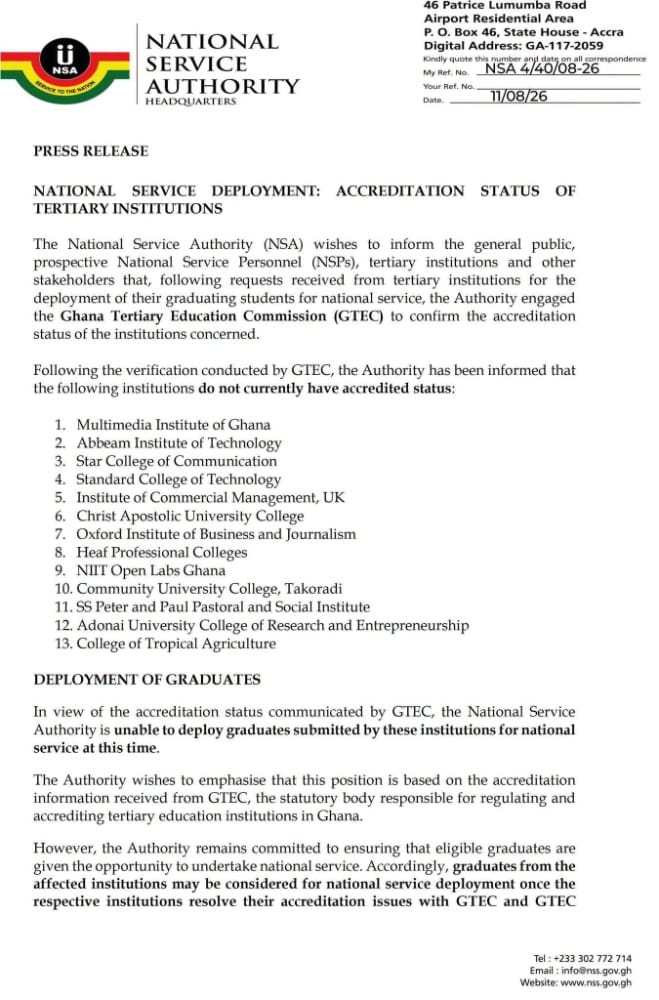
The NSA announced this in a press release dated August 11, 2026, after requests from tertiary institutions and prospective National Service Personnel for the deployment of graduating students.
The Authority said it engaged GTEC to verify the accreditation status of the institutions concerned.
Following the verification, GTEC informed the NSA that the 13 institutions “do not currently have accredited status.”
Full list of the 13 institutions
The institutions named by the National Service Authority are:
- Multimedia Institute of Ghana
- Abbeam Institute of Technology
- Star College of Communication
- Standard College of Technology
- Institute of Commercial Management, UK
- Christ Apostolic University College
- Oxford Institute of Business and Journalism
- Heaf Professional Colleges
- NIIT Open Labs Ghana
- Community University College, Takoradi
- SS Peter and Paul Pastoral and Social Institute
- Adonai University College of Research and Entrepreneurship
- College of Tropical Agriculture
What the NSA said about National Service deployment
The NSA said the accreditation information received from GTEC means it is unable to deploy graduates submitted by the affected institutions for national service at this time.
The Authority stressed that the decision is based on information provided by GTEC, which is responsible for regulating and accrediting tertiary education institutions in Ghana.
The announcement, however, does not permanently rule out national service for graduates of the affected institutions.
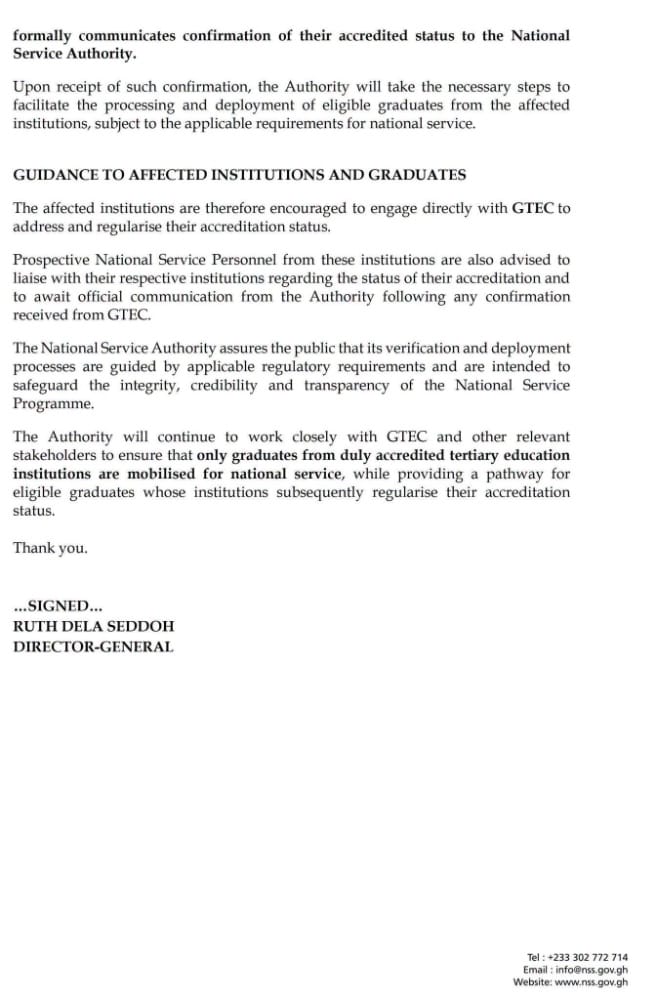
According to the NSA, graduates may be considered for deployment once their respective institutions resolve their accreditation issues with GTEC and GTEC formally confirms their accreditation status to the National Service Authority.
The NSA said that after receiving such confirmation, it will take the necessary steps to facilitate the processing and deployment of eligible graduates, subject to the applicable requirements for national service.
What affected institutions must do
The National Service Authority has advised the affected institutions to engage directly with GTEC to address and regularise their accreditation status.
Prospective National Service Personnel from the institutions have also been advised to liaise with their respective schools to establish the current status of their accreditation.
The NSA further urged affected graduates to wait for official communication from the Authority following any confirmation received from GTEC.
Why the accreditation issue matters
Accreditation is significant because the NSA said its deployment process is based on regulatory requirements governing eligible tertiary education institutions.
The Authority said its verification and deployment procedures are intended to safeguard the integrity, credibility and transparency of the National Service Programme.
It added that it would continue working with GTEC and other relevant stakeholders to ensure that only graduates from duly accredited tertiary education institutions are mobilised for national service.
Will graduates from the 13 institutions still be able to do national service?
Potentially, yes. The NSA has not said that affected graduates are permanently barred from national service.
Instead, the Authority said eligible graduates may be considered for deployment after their institutions resolve their accreditation issues and GTEC formally confirms their accredited status to the NSA.
This means the immediate responsibility rests with the affected institutions to engage GTEC and regularise their accreditation status.
What affected graduates should do
Graduates from the listed institutions should contact their respective schools for information about their accreditation status and any steps being taken to resolve the issue.
They should also rely on official communication from the NSA and their institutions rather than unverified information circulating on social media.
The NSA said it remains committed to ensuring that eligible graduates are given an opportunity to undertake national service once the applicable requirements have been satisfied.
The Breaking Desk's verification note
This report is based on a National Service Authority press release dated August 11, 2026, signed by Director-General Ruth Dela Seddoh.
The NSA's statement attributes the accreditation information to the Ghana Tertiary Education Commission. The wording “do not currently have accredited status” is used deliberately in this report because it reflects the Authority's stated position and does not imply that the institutions are permanently barred from obtaining accreditation.
Any subsequent change in the accreditation status of the affected institutions should be confirmed through GTEC and communicated officially by the relevant authorities.
Source: National Service Authority (NSA), press release dated August 11, 2026.
Read:
 FrimPong



Comments ()